Shopify / DTC Brand
Problem
I'm not sure whether my current UPC and label setup is enough.
Start with the checklist2D barcode readiness
For small brands, marketplace sellers, retail suppliers, and warehouse teams preparing for GS1 Sunrise 2027, 2D barcodes, scanner upgrades, and label printer decisions.
Independent guide - Not affiliated with GS1 - No purchase required
Readiness flow
SKU data -> label format -> scanner -> printer
Choose your starting point
Problem
I'm not sure whether my current UPC and label setup is enough.
Start with the checklistProblem
I'm confused by UPC, GTIN, FNSKU, and future 2D barcode requirements.
Read UPC after 2027Problem
A retail partner is asking about 2D barcode readiness.
Use the readiness calculatorProblem
Our scanners and label printers may not support future workflows.
Request a starter pathScenario paths
For DTC-only brands with low SKU count, no retail checkout exposure, no lot or expiry data, and no packaging update planned.
See if this fits my businessFor brands entering retail, adding batch or expiry data, or preparing a packaging refresh.
See if this fits my businessFor warehouses using older 1D laser scanners, unclear label printer specs, or growing SKU volume.
See if this fits my businessWhat happens next
No purchase is required. The goal is to translate your current channels, SKU count, scanner, printer, data needs, budget, and timeline into a practical next step.
For simpler teams that may not need immediate hardware spending.
For teams with unclear scanner, printer, software, or label-data readiness.
For brands entering retail, adding variable data, or preparing packaging updates.
For teams that likely need a focused starter hardware path.
Concise answer
GS1 Sunrise 2027 is an industry transition toward retail point-of-sale systems being able to read GS1-compliant 2D barcodes by the end of 2027. It does not mean UPC or EAN barcodes disappear overnight.
For many small brands, the practical next step is not a rushed redesign. It is a readiness audit: current selling channels, SKU count, label printer resolution, barcode scanner type, packaging schedule, and whether lot, batch, expiry, or digital product information may need to be encoded.
2D barcodes can carry more data than a traditional linear barcode, including GTIN, batch or lot data, expiration date, serial data, or a GS1 Digital Link where appropriate.
Do not remove your UPC or EAN just because you hear 2027. Many products will show both a linear barcode and a 2D barcode during the transition.
Always confirm the exact requirement with GS1, your marketplace, your retail partner, or a qualified compliance adviser.
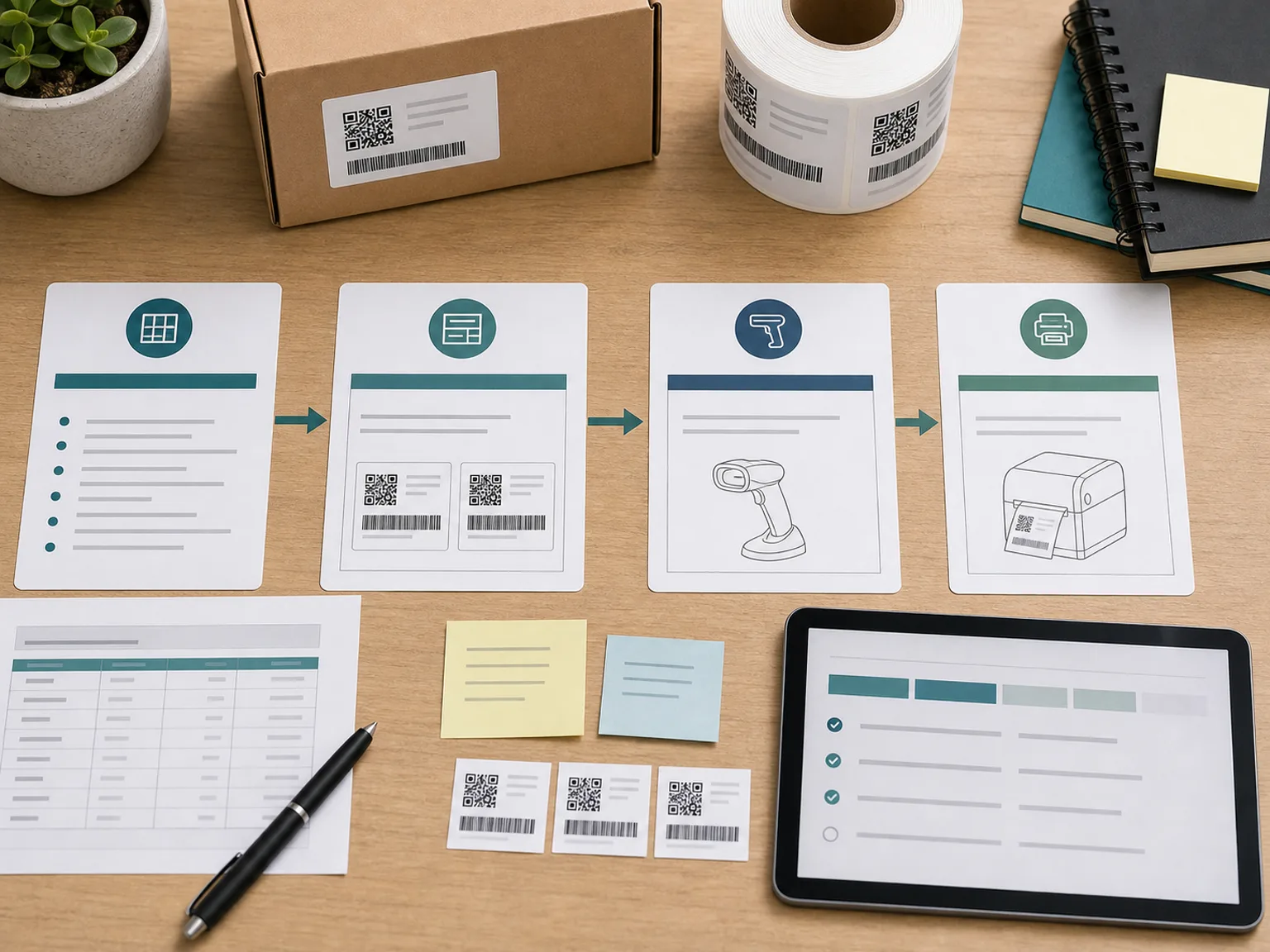
Practical workflow
The business question is simple: can your current packaging, printing workflow, scanner hardware, and marketplace or retail channel handle the transition?
Decision criteria
You sell into retail stores or retail suppliers are asking about 2D barcodes.
You manage perishable, batch-tracked, serialized, or recall-sensitive inventory.
Your warehouse still uses 1D laser scanners rather than 2D imagers.
Your label printer may not print dense 2D codes clearly enough.
You are already planning a packaging refresh or hardware upgrade.
Get the readiness checklist or request an independent starter recommendation based on your real SKU count, channels, hardware, timeline, and budget.
Use this as an educational planning baseline before confirming GS1 and partner requirements.
| Format | Primary role | Readiness note |
|---|---|---|
| 1D UPC/EAN | Identifies the product and works at legacy checkout. | Usually printed on existing packaging. |
| 2D barcode | Can carry richer data such as batch, expiry, serial, or web-linked information. | Requires 2D-capable scanning and correct data formatting. May need higher-resolution printing and updated artwork. |
| RFID | Not an optical barcode. | Useful for certain inventory workflows, but it is not the same as the Sunrise 2027 retail checkout transition. |
Retail suppliers, food or cosmetics brands with lot or expiry data, small warehouses replacing scanners, Shopify or Amazon sellers preparing for multi-channel retail, and brands already updating packaging artwork should audit now.
Very small direct-to-consumer brands with no retail checkout exposure, no variable data, no packaging refresh planned, and recently purchased 2D-capable hardware may not need immediate spending.
No. This site is independent and not affiliated with GS1.
No. The transition is gradual, and many products will continue to show linear barcodes during the transition.
Maybe. Dense 2D codes often benefit from 300 dpi or better printing, but exact requirements depend on code size, label material, printer condition, and verification standards.
If your scanner is a 1D laser scanner, it will not read 2D codes. A 2D imager is usually required.
No. Confirm GS1, marketplace, retailer, and regulatory requirements with the relevant authority or adviser.
SKU count, sales channels, current label printer, scanner type, software, daily label volume, deadline, and budget range.
Start with your current setup, not a shopping list. Tell us your SKU count, selling channels, current scanner type, label printer model or DPI, packaging timeline, and approximate budget.
Disclaimer
This site is independent and not affiliated with GS1. It provides educational readiness guidance only, not legal, compliance, marketplace, retailer, or GS1 approval advice.